By SBS Brokers
Sectional Title Insurance. Trustee vs Owner Responsibilities
Table of Contents
Toggle
In a Sectional Title Scheme, the Body Corporate insures the buildings and common property, while individual owners are responsible for insuring their contents and certain private risks, subject to scheme rules and policy wording. Confusion around these responsibilities is one of the leading causes of disputes during claims.
A Trustees’ Guide to Sectional Title Insurance in South Africa

Why Responsibility Confusion Is the Biggest Risk Trustees Face
Serving as a Trustee or Managing Agent in a Sectional Title Scheme involves far more than attending meetings, approving maintenance, or managing levies. Trustees are entrusted with protecting the financial stability of an entire community, often representing dozens or even hundreds of individual owners with shared interests, shared assets, and shared risks. Insurance sits at the centre of that responsibility.
When Sectional Title Insurance responsibilities are clearly defined and properly structured, claims are processed efficiently, repairs happen faster, and disputes are minimised. Owners understand what is covered, Trustees can act decisively, and the scheme continues operating with minimal disruption.
When responsibilities are unclear, even a relatively minor claim can escalate into conflict. Repairs are delayed. Arguments arise between Trustees and owners. Unexpected special levies are introduced. Relationships within the scheme become strained, and trust erodes quickly.
In practice, most Sectional Title Insurance disputes are not caused by missing insurance cover. They are caused by uncertainty around a single, deceptively simple question:
Who is responsible for insuring what?
This article focuses on that question and how Trustees can prevent disputes before a claim ever occurs.
Avoiding Sectional Title Insurance Disputes
In the video above, we explore the most common responsibility disputes Trustees face in Sectional Title Schemes and explain why these disputes tend to surface during claims, not at policy inception. The video introduces a practical responsibility decision framework that Trustees can use to assess whether an item should be insured by the Body Corporate or by an individual owner.
This article expands on that framework and explains how it applies in real-world sectional title scenarios, giving Trustees the context they need to make confident, defensible decisions.nd reviews.
Understanding Shared Ownership in Sectional Title Schemes
Sectional title insurance exists because ownership in a scheme is shared.
In a freehold property, one Owner is responsible for the entire structure, the land, and all associated risks. In a Sectional Title Scheme, ownership is divided:
- Individual owners own their individual sections
- The Body Corporate, on behalf of all owners, owns and manages the buildings and common property
Because ownership is divided, insurance responsibility is also divided.
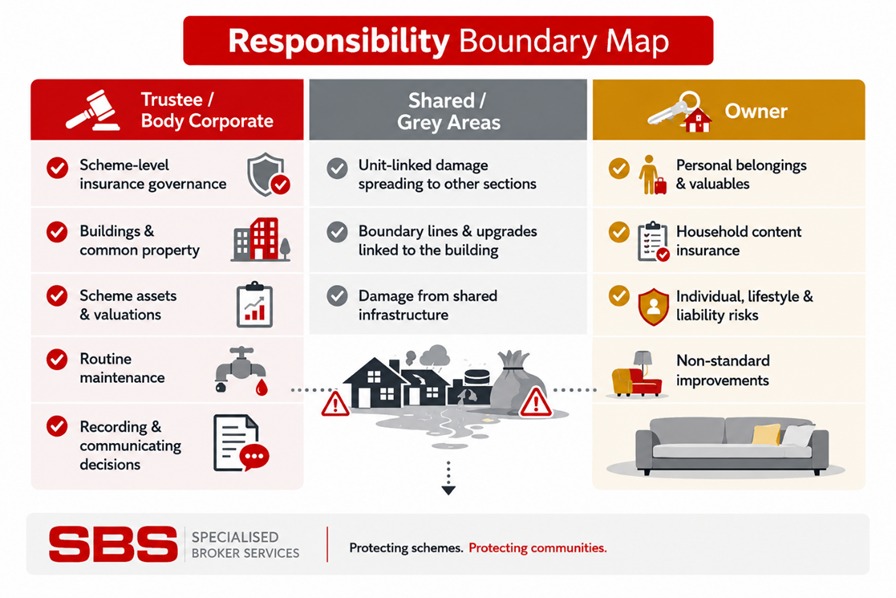
The Body Corporate carries responsibility for insuring shared structures and common risks, while individual owners are responsible for insuring their personal belongings and certain private risks within their sections. On paper, this distinction seems straightforward. In practice, it is precisely this boundary that creates the majority of disputes.
Many owners assume the scheme insurance covers everything inside their unit, while many Trustees assume owners understand where their personal responsibility begins. When a claim occurs and these assumptions collide, confusion quickly turns into conflict. Clear boundaries between Scheme insurance and Owner insurance are not just helpful, they are essential for smooth claims handling and effective scheme governance.
What the Body Corporate Must Insure by Law
Insurance obligations for Sectional Title Schemes are not optional. They are defined by South African legislation, specifically the Sectional Titles Schemes Management Act and the Prescribed Management Rules. At a minimum, the Body Corporate is required to maintain insurance for:
These covers exist to protect the collective financial interests of owners and to support proper governance within the scheme. The most critical requirement, and the one most frequently misunderstood, is replacement value insurance.
Why Replacement Value Is So Often Misunderstood
Replacement value is not market value. It is not the price a property might sell for. It is not what the buildings cost to construct ten or fifteen years ago.
Replacement value is the realistic cost to rebuild the property today, using current labour rates, material costs, professional fees, and regulatory requirements. Construction costs increase steadily over time. If insured values are not reviewed and updated regularly, schemes become underinsured without realising it. When underinsurance exists, claims do not fail entirely. Instead, they may faily partially and be settled proportionally depending on policy terms. The Replacement Value must include debris and rubble removal.
A claim may be paid out, but not enough to cover the full cost of repairs or rebuilding. The shortfall must then be funded by owners, usually through special levies. Underinsurance is one of the most expensive and damaging risks a Body Corporate can face, and it is often preventable with regular valuations and reviews.
Liability Exposure for Financial Advisors, Accountants, and Auditors
Financial advisors, accountants, auditors, actuaries, and related professionals provide specialised financial advice, prepare reports, and audit financial statements. Errors, omissions, or negligent misstatements can result in substantial client losses and subsequent claims.
South African case law, including International Shipping Co v Bentley, demonstrates that professionals can be held liable for negligent financial reporting. As a result, Professional Indemnity Insurance is commonly required under FAIS regulations, professional body rules (such as SAICA), and institutional client mandates.
For these professions, PI cover is not discretionary; it is a regulatory and ethical requirement to practice.
Professional Indemnity Insurance Requirements for Pharmacists
Pharmacists, pharmaceutical consultants, and related professionals are legally required to maintain Professional Indemnity Insurance in terms of Board Notice 83 of 2008. This requirement applies to the full scope of professional services provided. The Pharmaceutical Society of South Africa (PSSA) facilitates a Professional Indemnity Insurance Plan (PIP) to assist members in meeting statutory obligations while protecting against claims arising from professional services.
Professional Indemnity and Liability Risks for Psychologists and Allied Health Professionals
Psychologists, therapists, and allied health practitioners face exposure arising from diagnostic errors, negligent therapy, breaches of confidentiality, defamation, and professional misconduct allegations. Registered psychologists are required to maintain Professional Indemnity Insurance as part of professional and ethical compliance. Policies are typically structured to include extensions such as breach of confidentiality cover and defence costs for HPCSA-related proceedings, reflecting the unique risks of this profession.
Professional Indemnity Insurance for IT and Consulting Firms
IT consultants, software developers, data analysts, and management consultants may not always be legally compelled to hold Professional Indemnity Insurance. However, client contracts, procurement standards, and tender requirements frequently make PI cover a practical necessity. These professionals implement business-critical systems and provide expert advice, creating exposure to claims arising from defective solutions, configuration errors, project delays, data breaches, intellectual property disputes, and confidentiality failures. Professional Indemnity Insurance helps protect both the firm’s financial position and its professional reputation.
Where Most Sectional Title Insurance Disputes Come From
Even well-managed schemes often carry hidden insurance risks. These issues usually only become visible when something goes wrong.
1. Underinsurance
Underinsurance develops gradually. Building costs rise. Improvements are made. Infrastructure is upgraded. The insured value remains unchanged. Everything appears fine until a major incident occurs, such as a fire, a storm, or extensive water damage. When the claim is assessed, the payout does not cover the full cost of repairs.
The difference may result in a shortfall that owners may need to fund, often unexpectedly and at short notice. For Trustees, this situation is particularly difficult because it is usually avoidable with regular valuations and policy reviews. The Managing Agent or Body Corporate are required, by law to arrange a full replacement report every 3 years.
2. Responsibility Confusion
Many disputes are not caused by missing insurance, but by a misunderstanding of responsibility. Common examples include:
- Are internal improvements covered?
- Who insures exclusive-use areas?
- What happens when damage affects more than one section?
Without clear guidance, each claim becomes a debate. Debates delay repairs. Delays increase frustration. Frustration damages trust. Clear responsibility rules significantly reduce these issues.
3. “Set and Forget” Insurance Policies
Sectional Title Insurance should never be treated as something arranged once and ignored. Sectional Title Schemes change constantly. Units are renovated. Security systems are added. Property values increase. Risk exposure evolves. Policies that are not reviewed regularly become misaligned with the reality of the scheme. Good governance means treating insurance as an ongoing management responsibility, not a once-off administrative task.
A Practical Responsibility Test for Trustees
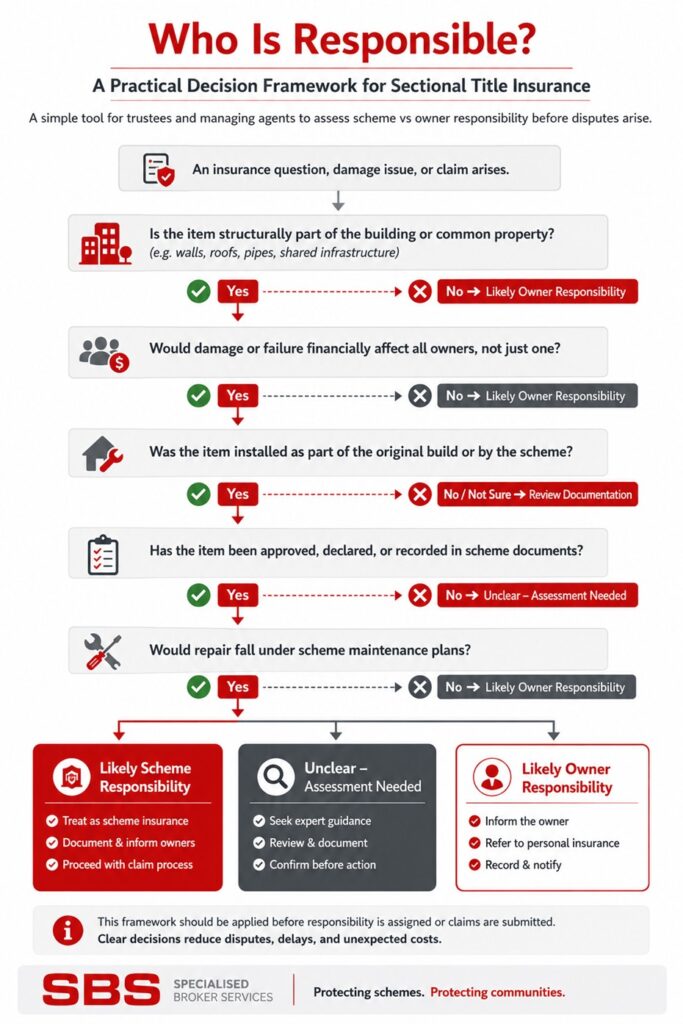
When Trustees are unsure who should insure a specific item, a simple decision framework can help.
Ask the following questions:
- Is the item part of the building structure or common property?
- Would damage to the item affect more than one section?
- Was the item included in the original development or approved by the scheme?
- Or is it movable and personal to the owner?
If the risk impacts the scheme, it is usually a Body Corporate responsibility. If it is personal, movable, and limited to one section, it is usually an Owner’s responsibility. Using this framework consistently helps Trustees make fair, defensible decisions and prevents disputes before claims occur.
Tip! Check out the responsibility decision framework, practical examples, and Trustee checklist, which are included in Chapter 5 of the Sectional Title Guide for Trustees. Download Free Now.
Why Specialist Sectional Title Advice Matters
Sectional title insurance is fundamentally different from ordinary household or commercial insurance. It involves:
- Legal compliance obligations
- Collective ownership structures
- Governance and fiduciary risk
- Shared financial exposure across multiple owners
A general broker may be able to arrange a policy, but a specialist insurance broker such as SBS understands how Sectional Title Schemes operate in practice, especially when claims arise. This allows Trustees to consider how cover will respond at claim stage and structure insurance more appropriately around the scheme’s specific circumstances.
Specialised Broker Services works specifically with Body Corporates and Trustees, assisting with:
- Policy structuring aligned to scheme realities
- Responsibility clarity, and documentation
- Ongoing insurance reviews
Practical Steps Trustees Can Take Today
Trustees do not need to become insurance experts. They need a clear, repeatable process.
Start with these steps:
- Review building sums insured annually
- Obtain professional replacement value valuations every two to three years
- Clearly document what the scheme insures versus what owners must insure themselves
- Communicate these boundaries to owners regularly
- Work with a specialist broker who understands sectional title risk
Small proactive actions today prevent large financial disputes later.
When Claims Happen, It’s Already Too Late to Clarify Responsibilities
Insurance does not fail gradually. It fails during a crisis.
- A burst pipe floods multiple units.
- A storm damages roofing.
- A fire affects several sections.
- A visitor is injured on common property.
These are the moments when Trustees discover whether their Sectional Title Insurance structure truly works.
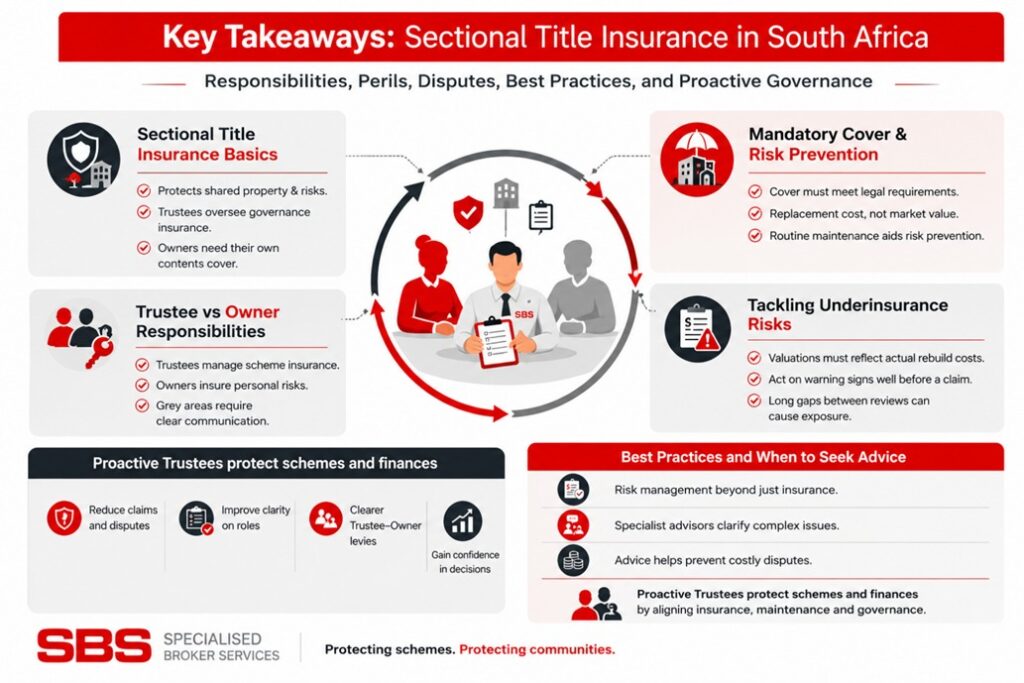
Trustees who clarify responsibilities, review cover regularly, and use specialist advice protect not only buildings, but also the financial stability and trust of their communities. If responsibilities feel unclear, that is usually the first sign it is time to reassess. If you are uncertain about Trustee vs Owner responsibilities in your sectional title scheme, that uncertainty is a signal, not a failure. It is an opportunity to review, correct, and strengthen your insurance structure before it is tested under pressure.
The Sectional Title Insurance Trustee Guide includes a dedicated chapter on responsibility clarity, featuring:
- A practical “who insures what” decision framework
- Real-world examples of common dispute scenarios
- A Trustee checklist to prevent responsibility confusion before claims occur
Prefer Expert Guidance? Request a Free Sectional Title Consultation
If your scheme requires tailored advice, policy review, or clarity around Body Corporate insurance duties, the team at Specialised Broker Services offers specialist support for Trustees and Managing Agents. A short consultation can help identify gaps, confirm responsibilities, and ensure your sectional title insurance structure is aligned with legal requirements and real-world risk. Contact SBS for a free Sectional Title Insurance Consultation
Frequently Asked Questions
Yes. The Sectional Titles Schemes Management Act requires the Body Corporate to maintain adequate insurance for the buildings and common property, as well as liability cover. This is a legal obligation, not an optional decision.
The Body Corporate must insure the buildings and common property at full replacement value. This typically includes the structural elements of the scheme, shared infrastructure, and approved original fixtures. In addition, schemes should carry public liability, trustee indemnity, and fidelity guarantee insurance to protect the collective interests of owners.
Individual owners are responsible for insuring their personal contents, movable items, and certain internal improvements that are not part of the original structure. Owners may also need personal liability cover for risks arising within their section. Clear communication of these boundaries helps prevent disputes when claims occur.
No. Body Corporate insurance generally covers the building structure and shared elements, not personal belongings. Certain owner-specific improvements may be insured under the sectional title policy if they are declared and added to the cover for that unit as an “additional sum insured”. This is why clear documentation and responsibility clarity are essential to avoid disputes at claim stage.
Who pays depends on what was damaged and who is responsible for insuring it. If the damage affects insured building elements or common property, the Body Corporate’s policy may respond. If the damage involves personal contents or owner-installed improvements, the owner is usually responsible. This distinction should be clarified before claims occur.
Replacement value is the realistic cost to rebuild the property today using current labour and material prices, Inclusive of debris & rubble Removal and Professional Fees. It is not the market selling price. If replacement values are outdated, the scheme may be underinsured, leading to claim shortfalls and special levies.
Unclear responsibilities delay claims, create disputes between trustees and owners, and often result in unexpected financial contributions. Clear responsibility definitions allow claims to be processed faster and reduce conflict within the scheme.
Most disputes arise from assumptions rather than missing cover. When trustees and owners have different expectations about who insures what, claims quickly become contentious. Regular reviews, clear documentation, and specialist advice significantly reduce this risk.
Yes. Sectional title schemes involve shared ownership, legal compliance, and governance risk that differ from ordinary household insurance. A specialist broker understands how these schemes operate in practice and helps trustees structure cover that works when claims happen.
A Trustees’ Guide to Sectional Title Insurance in South Africa