By SBS Brokers
Small Business Insurance South Africa and What Cover Do You Actually Need?
Table of Contents
Toggle
Most South African SMEs should start by assessing property insurance, public liability insurance, and business interruption insurance. These core covers help protect the business against asset loss, third-party claims, and loss of income after a disruptive event. Additional covers such as professional indemnity, cyber insurance, or fidelity cover may then be added depending on the nature of the business.
For many small business owners, insurance feels confusing from the start. There are so many policy types, technical terms, optional extras, and warnings about potential issues that it becomes difficult to determine what is essential and what can wait. In many cases, SMEs end up underinsured because they opt for the cheapest available cover, or they forget insurance altogether because the decision feels overwhelming.
That is understandable. Running a business already involves managing cash flow, staff, customers, suppliers, compliance, and growth. Insurance often gets pushed down the list until there is a problem. Unfortunately, that is usually the point at which the gaps become obvious and expensive. The better approach is to start with the core covers most businesses should have first, then build from there as the business grows or becomes more complex. A sound insurance structure does not need to start with every possible section of cover. It needs to begin with the cover sections that protect the business against the most immediate and financially damaging risks.
For many South African SMEs, that means focusing first on property-related cover, public liability, and business interruption, before layering more specialised policies such as cyber insurance, professional indemnity, fidelity cover, or legal protection where relevant.
At Specialised Broker Services, this kind of advice starts with understanding the business properly and helping owners prioritise the cover that matters most instead of treating insurance as a generic box-ticking exercise.
What insurance does a small business actually need in South Africa?
The short answer is that most small businesses need protection against three broad types of risk:
- damage to business assets or premises
- claims from third parties
- loss of income after a disruptive event
These risks affect many businesses regardless of industry. A retail store, professional practice, hospitality business, workshop, contractor, or office-based SME may all face different operational realities, but most still depend on physical assets, public interaction, and continuity of income.
That is why a practical starting point is usually some form of commercial insurance structured around the actual activities and exposures of the business. From there, the business can assess whether it also needs more specialised protection based on its sector, service model, staff structure, contractual exposure, or digital risk.
Why do many SMEs get business insurance wrong?
One of the most common mistakes small businesses make is assuming that insurance can be sorted out quickly with a standard package and a low premium. While there are entry-level products that can be suitable in some cases, the risk is that the owner believes the business is protected when the cover is actually too narrow, outdated, or missing something important.
This often happens because:
- The sum insured is too low
- The owner only insures contents and not the wider business exposure
- Liability risks are ignored
- An interruption to income is not considered
- The policy wording is not fully understood
- The cover is bought based only on price
Another issue is that many SMEs do not review their insurance as the business changes. A company that started as a small operation may later add equipment, staff, stock, vehicles, new premises, or professional services, but the insurance may remain much the same as it was in the beginning.
That is where specialised business insurance advice becomes valuable. Rather than relying on a generic template, the cover can be shaped around the real activities, assets, and risks of the business.
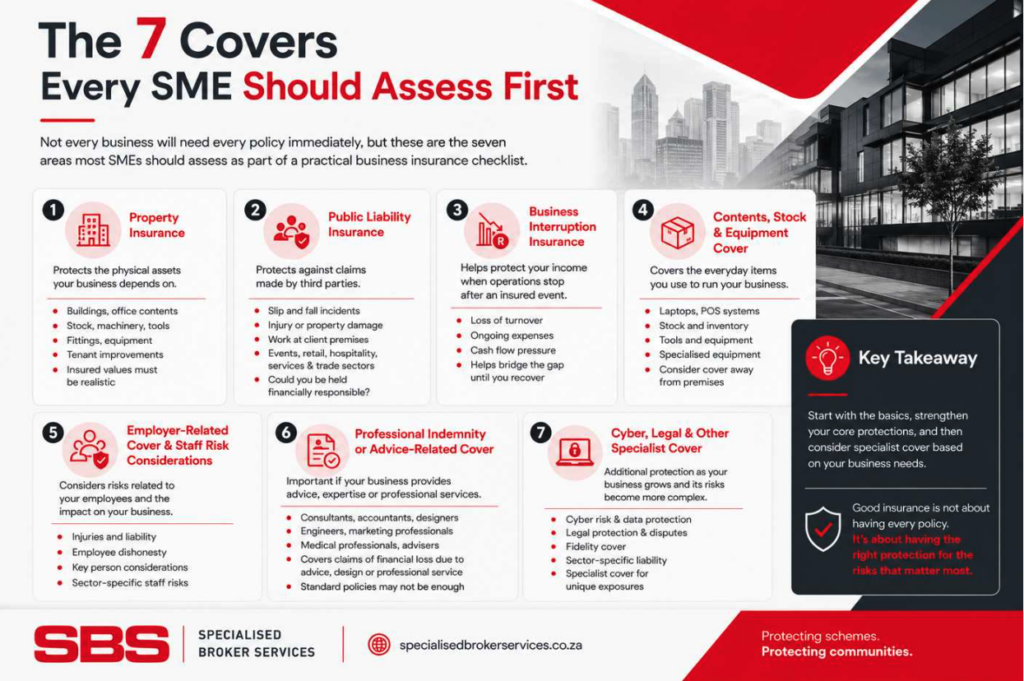
The 7 covers every SME should assess first
Not every business will need every policy immediately, but these are the seven areas most SMEs should assess as part of a practical business insurance checklist.
1. Property insurance
Property insurance is usually one of the first essentials for a small business. This protects the physical assets the business depends on, which may include buildings, office contents, furniture, fittings, machinery, tools, stock, and equipment.
Even if the business rents its premises, it may still own significant contents or improvements that need coverage. A fire, burst pipe, storm event, theft, or accidental damage incident can cause major financial strain if those assets need to be replaced quickly.
Property insurance is often relevant if your business has:
- office equipment
- stock or inventory
- machinery or tools
- signage, fittings, or fixtures
- tenant improvements
- storage facilities
- specialised equipment
The key issue here is not just having cover, but making sure the insured values are realistic. Underinsurance is a common problem. If the insured amount is too low, the business may not receive the full value of a claim.
2. Public liability insurance
Public liability insurance is one of the most overlooked covers among SMEs, especially businesses that assume they are too small to be sued or that liability is only relevant to high-risk industries. In reality, many everyday interactions can give rise to third-party claims.
A customer could slip on a wet floor. A supplier could be injured on-site. A contractor could cause accidental damage to another party’s property while working. Even a seemingly minor incident can become expensive once medical costs, legal costs, or damages are involved.
Public liability is particularly important for businesses that:
- have customers or members of the public on-site
- work at client premises
- attend events or exhibitions
- operate in hospitality, retail, wellness, services, or trade sectors
- deliver installation, maintenance, or physical services
The question is not whether your business intends to cause harm. It is whether it could be held financially responsible if something goes wrong.
3. Business interruption insurance
This is one of the most important covers for business survival, yet many SMEs do not have it. Business interruption insurance helps protect the income of the business after an insured event disrupts normal operations.
For example, if a fire damages your premises and you cannot trade for several weeks or months, the financial impact is not only the cost of repairing the building or replacing equipment. It is also the loss of turnover, ongoing expenses, and pressure on cash flow while the business tries to recover.
Business interruption insurance is designed to help bridge that gap.
This can be critical for businesses that rely on:
- one key premise
- physical operations
- customer foot traffic
- production capacity
- specialist equipment
- stable monthly income to meet overheads
Without an interruption cover, a business may survive the initial event but still struggle to recover from the loss of income that follows.
4. Contents, stock, and equipment cover
Although often grouped under broader property insurance, this area deserves separate attention because many SMEs underestimate the value of the items they use every day.
This includes:
- laptops and computers
- point-of-sale systems
- stock on shelves or in storage
- manufacturing tools
- salon or medical equipment
- catering equipment
- mobile business tools
- specialist trade equipment
The loss of these items can interrupt operations immediately. For some businesses, even a short-term loss can mean missed deadlines, cancelled appointments, or the inability to deliver services.
Owners should also consider whether certain items need cover away from the premises, especially if staff travel with equipment or work off-site.
5. Employer-related cover and staff risk considerations
If you employ people, even in a small team, there are additional risks and exposures to think about. While not every staff-related risk is handled under the same insurance policy, it is important to consider how injuries, employee dishonesty, liability, and operational disruption involving staff could affect the business.
For some SMEs, this may extend into fidelity-related risks, key person considerations, or more sector-specific protection depending on the nature of the work.
This is an area where owners often assume they are covered because they have a basic business policy, when in reality, some staff-related exposures require more specific review.
6. Professional indemnity or advice-related cover
Not every small business needs professional indemnity insurance, but many do. If your business provides advice, recommendations, design work, consulting, expertise, or professional services, then a claim may arise not because of physical damage, but because a client believes your service caused financial loss.
This applies to many types of businesses, including:
- consultants
- accountants
- designers
- engineers
- marketing professionals
- medical professionals
- advisers
- technical service providers
In these cases, professional and indemnity insurance may be a necessary layer of protection in addition to general business cover. A standard business policy is not always enough to deal with professional negligence or advice-based claims. That is why it is important to understand where basic business insurance ends and more specialised cover begins.
7. Cyber, legal, and other specialist cover
Once the core protections are in place, the next step is to consider whether the business has additional risks that justify more specialised policies.
This may include:
- cyber risk if the business stores customer data, uses cloud systems, or depends heavily on digital operations
- legal protection if the business faces ongoing contractual or employment-related disputes
- Fidelity cover where staff handle money or financial transactions
- sector-specific liability or asset protection, depending on the business model
These policies are not always the first step, but they become increasingly important as the business grows or its risk profile becomes more exposed. The key is not to jump straight into every specialist policy without first covering the most fundamental exposures.
What insurance is compulsory for small businesses in South Africa?
This is a common question, but the answer depends on the nature of the business. There is no single rule that says every small business in South Africa must have the exact same insurance policy. However, certain covers may become effectively compulsory depending on the industry, lease agreement, client contracts, licensing requirements, or professional obligations of the business.
For example:
- A landlord may require certain cover under a lease
- A client contract may require liability insurance
- A professional body may expect indemnity cover
- An event venue may require proof of liability insurance
- A funder or lender may require protection over insured assets
So while not every policy is legally compulsory in a general sense, many SMEs still need insurance because of contractual, commercial, or professional requirements. The more useful question is often not “what is compulsory?” but “what could place my business at serious risk if I do not have it?”
Do I need public liability insurance for my business?
In many cases, yes. If your business interacts with customers, suppliers, contractors, or the public in any physical setting, public liability insurance is worth serious consideration. Many owners underestimate how easily an incident can happen and how costly a claim can become.
This is especially relevant if your business:
- operates from premises visited by third parties
- performs work at client sites
- hosts events
- delivers on-site services
- uses equipment that could cause accidental injury or damage
- works in shared commercial spaces
Liability claims do not only affect large companies. Small businesses can be just as exposed and often have less of a financial buffer to absorb the impact.
What risks are not covered by basic business insurance?
Basic business insurance can be very useful, but it is not designed to cover every kind of loss. Depending on the policy, basic cover may not fully address:
- cyber incidents and data breaches
- professional errors or negligent advice
- certain legal disputes
- employee dishonesty
- reputational loss
- contractual liabilities beyond policy scope
- deliberate acts or fraudulent claims
- losses resulting from underinsurance or non-disclosure
This is why a business should not assume that having “business insurance” means every possible risk is covered. Owners need to understand what the policy includes, what it excludes, and what additional coverage may be needed later.
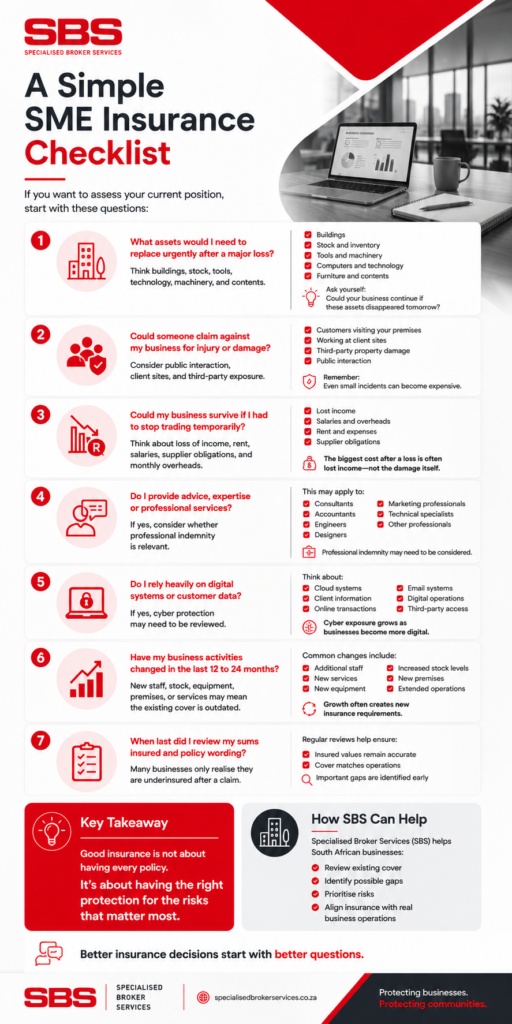
A simple SME insurance checklist
If you want to assess your current position, start with these questions:
- What assets would I need to replace urgently after a major loss?
Think buildings, stock, tools, technology, machinery, and contents.
- Could someone claim against my business for injury or damage?
Consider public interaction, client sites, and third-party exposure.
- Could my business survive if I had to stop trading temporarily?
Think about loss of income, rent, salaries, supplier obligations, and monthly overheads.
- Do I provide advice, expertise, or professional services?
If yes, consider whether professional indemnity is relevant.
- Do I rely heavily on digital systems or customer data?
If yes, cyber protection may need to be reviewed.
- Have my business activities changed in the last 12 to 24 months?
New staff, stock, equipment, premises, or services may mean the existing cover is outdated.
- When last did I review my sums insured and policy wording?
Many businesses only realise they are underinsured after a claim. This is where working with a business insurance broker in South Africa can make the process clearer. A broker can help identify gaps, explain priorities, and make sure the cover reflects the actual risk profile of the business.
How a broker helps reduce confusion and identify insurance gaps
Many SME owners do not need more jargon. They need practical clarity. A broker’s role should not simply be to send through a quote and ask whether you want to proceed. A good broker helps you understand:
- What your main risks are
- Which covers are essential first
- Where your current gaps may be
- Whether your sums insured are realistic
- When specialist policies should be added
- How to balance cost with meaningful protection
This is also where the difference between selling and advising becomes important again. For a small business owner, insurance decisions are easier when someone helps translate the risks into practical priorities instead of just listing policy names.
Final thoughts
If you are a small business owner trying to work out what insurance you actually need, the answer is usually simpler than it first appears.
Start with the covers that protect your business against the most immediate threats:
- property and assets
- public liability
- business interruption
Then assess whether your business also needs additional protection for advice-based risks, cyber exposure, employee dishonesty, or legal and contractual pressures. The goal is not to buy every policy available. The goal is to make sure the business is protected where it is most exposed, and to avoid the common trap of underinsurance.
For many SMEs, the smartest next step is not buying more insurance blindly. It is taking stock of the risks properly and building cover in the right order. If you would like help identifying gaps in your current cover, you can contact Specialised Broker Services or book a Zoom meeting to review your business insurance requirements.
If you would like to review whether your current insurance structure matches the complexity of your risk, you can contact Specialised Broker Services or book a Zoom meeting with the team.
Frequently Asked Questions
There is no single insurance policy that every small business is legally required to have in all cases. However, certain covers may be required by lease agreements, client contracts, professional bodies, lenders, or industry-specific obligations.
If your business interacts with customers, suppliers, contractors, or the public, public liability insurance is often worth serious consideration. It helps protect the business if a third party claims for injury or property damage linked to your business activities.
Business interruption insurance helps cover loss of income and certain ongoing expenses if the business cannot operate normally after an insured event, such as fire or major property damage. It is designed to support the business while it recovers.
Basic business insurance may not cover every risk. Depending on the policy, this can include cyber incidents, professional negligence, certain legal disputes, employee dishonesty, reputational damage, and losses caused by underinsurance or non-disclosure.
You should consider cyber insurance if your business relies heavily on digital systems, online operations, or customer data. Professional indemnity becomes important where the business provides advice, expertise, consulting, design, or professional services that could lead to financial loss claims.
A broker can assess the actual activities, assets, and exposures of the business, explain which covers are most important first, review whether sums insured are realistic, and identify where additional protection may be needed beyond a basic business policy.