By SBS Brokers
Specialist vs General Insurance Brokers and Why Expertise Matters for Complex Risk
Table of Contents
Toggle
Who can give me cover at the right price? That is understandable. Insurance is a grudge purchase for many people, and it is easy to view brokers as people who simply source quotes and help place a policy.
When people look for insurance, they often begin with the same question: Who can give me cover at the right price? That is understandable. Insurance is a grudge purchase for many people, and it is easy to view brokers as people who simply source quotes and help place a policy.
In reality, the quality of advice behind the policy matters just as much as the premium, and in some cases, far more. This becomes especially important when the risk is complex, high-value, unusual, or commercially significant. In these situations, the difference between a general insurance broker and a specialist insurance broker can have a direct impact on how well the policy performs when it is needed most. Many policyholders only discover this after a problem arises. A claim is challenged. An exclusion is raised. A limit is too low. A policy responds differently to what the insured expected. By then, the focus shifts away from what the premium was and onto whether the cover was structured properly in the first place.
This is why specialist insurance advice matters. It is not about sounding more technical or charging more for the same service. It is about understanding the risk in greater depth, placing cover with more care, and helping clients avoid the costly gaps that often sit hidden inside policies that appeared suitable at the quote stage.
This approach is rooted in understanding the difference between simply placing cover and giving clients advice that is tailored to the realities of their risk which is our top priority at Specialised Broker Services.
What is the difference between a specialist and a general insurance broker?
A general insurance broker usually works across a broad mix of personal and business insurance needs. This may include household insurance, vehicles, personal lines, smaller business packages, and standard commercial cover. A general broker can be the right fit where risks are straightforward and where the insurance requirement does not need particularly technical analysis.
A specialist broker works differently. Their role is more focused on risks that require deeper interpretation, more detailed structuring, and a stronger advisory approach. This may involve complex property portfolios, community schemes, commercial exposures, technical operations, liability issues, or businesses with specialised insurance needs.
The core difference is not simply what products they offer, iIt is the depth of risk understanding they bring to the process.
- A general broker may be able to obtain cover.
- A specialist broker is more likely to interrogate whether that cover actually fits the risk.
That distinction matters because insurance is rarely just about whether a policy exists. It is about whether the terms, conditions, extensions, and limits reflect the real-world exposure of the insured. A broker who understands this properly can often spot issues before they become expensive.
This is also where the difference between selling and advising becomes important. A client with complex exposures often needs more than a quotation. They need insight, guidance, and a broker who understands how insurance should respond in practice.
Why this distinction matters more for complex risk
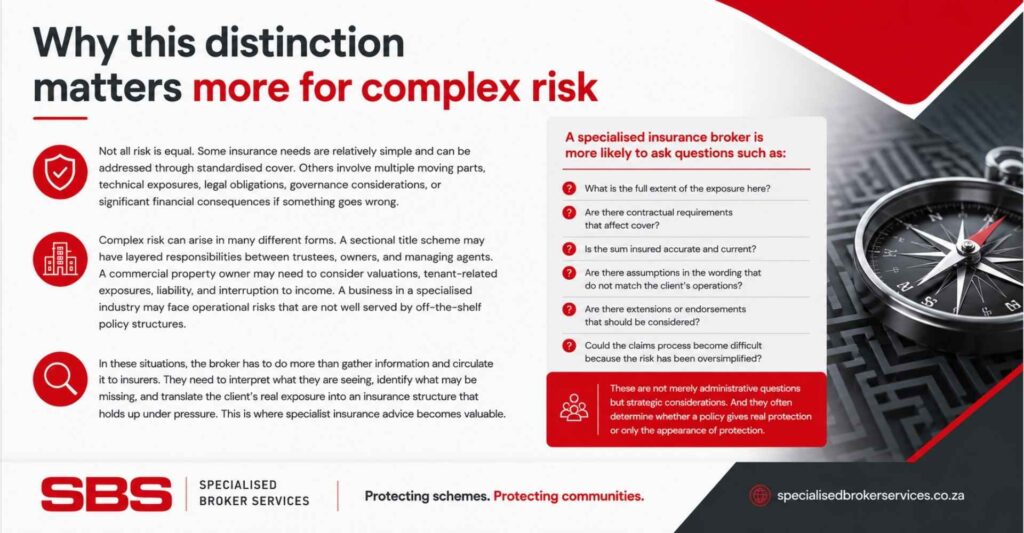
Not all risk is equal. Some insurance needs are relatively simple and can be addressed through standardised cover. Others involve multiple moving parts, technical exposures, legal obligations, governance considerations, or significant financial consequences if something goes wrong.
Complex risk can arise in many different forms. A sectional title scheme may have layered responsibilities between trustees, owners, and managing agents. A commercial property owner may need to consider valuations, tenant-related exposures, liability, and interruption to income. A business in a specialised industry may face operational risks that are not well served by off-the-shelf policy structures. In these situations, the broker has to do more than gather information and circulate it to insurers. They need to interpret what they are seeing, identify what may be missing, and translate the client’s real exposure into an insurance structure that holds up under pressure.
This is where specialist insurance advice becomes valuable. A specialised insurance broker is more likely to ask questions such as:
- What is the full extent of the exposure here?
- Are there contractual requirements that affect cover?
- Is the sum insured accurate and current?
- Are there assumptions in the wording that do not match the client’s operations?
- Are there extensions or endorsements that should be considered?
- Could the claims process become difficult because the risk has been oversimplified?
These are not merely administrative questions butstrategic considerations. And they often determine whether a policy gives real protection or only the appearance of protection.
Insurance is not only a price comparison exercise
A common mistake in the market is to treat insurance as though it were easy to compare line by line. Many people assume that if two policies look similar and one is cheaper, the decision is obvious. That may be true for simple insurance needs. It is much less reliable when the risk becomes more complex.
The problem is that policies can look similar at a summary level while behaving very differently in practice. One policy may appear cheaper because it contains narrower wording, lower sub-limits, stricter conditions, or exclusions that are easy to overlook. Another may seem more expensive at first glance but offer stronger protection in the areas that actually matter. This is one of the key areas where a specialist broker adds value. They help clients compare insurance meaningfully, not superficially.
That means looking beyond:
- the headline premium
- the insurer name
- a short list of apparent benefits
- a broad assumption that all policies are more or less the same
Instead, the comparison needs to consider whether the cover responds appropriately to the risk, whether the wording supports the intended protection, and whether the policy is likely to perform well if a claim occurs. In complex risk environments, a price without context can be misleading.
A policy that saves money upfront but leaves critical gaps can prove far more expensive later. Underinsurance, restrictive conditions, claims delays, and disputed interpretations all carry financial consequences. That is why experienced clients often place greater value on advice quality than on the lowest immediate premium.
What specialist insurance advice looks like in practice
Specialist advice is not about overcomplicating the process. In fact, good specialist advice often makes the process clearer because it brings structure and insight to decisions that might otherwise be made too quickly.
In practice, a specialist broker may help by:
Understanding the client’s risk profile more thoroughly
Rather than relying only on standard proposal information, they examine how the business or asset actually operates, where the vulnerabilities lie, and what would happen if a major loss occurred.
Identifying cover gaps and grey areas
A specialist broker can often spot issues that may not be obvious to a client, such as misaligned limits, outdated valuations, unclear responsibilities, or policy assumptions that do not reflect the real risk.
Structuring cover to suit the exposure
Instead of forcing the risk into a generic template, they help tailor the policy structure so it better reflects the client’s needs. This is particularly important for businesses that require specialised business insurance rather than a generic one-size-fits-all policy.
Improving insurer communication
Some risks need careful explanation to underwriters. A broker with specialist knowledge can present the risk more accurately and more credibly, which may improve terms or reduce misunderstandings.
Supporting claims with greater technical understanding
When claims arise, a specialist broker is often better equipped to assist with documentation, interpretation, and engagement around policy response.
All of this contributes to a stronger outcome, even though much of the value sits behind the scenes.
When a general broker may be enough
It is important to keep this discussion balanced. A general broker is not automatically the wrong choice. For many individuals and smaller businesses with straightforward insurance requirements, a general broker may be entirely suitable.
If the insurance need is standard, the assets are uncomplicated, and the policyholder mainly requires accessible service and a broad market comparison, a general broker can provide useful support. The issue is not whether general brokers are good or bad. The issue is whether the level of expertise matches the complexity of the risk.
Problems tend to arise when a client with layered or specialised exposures is treated as though their insurance needs are simple. In those cases, a generalist approach may not ask enough questions, challenge enough assumptions, or structure the cover with the precision required.
When specialist advice becomes particularly important
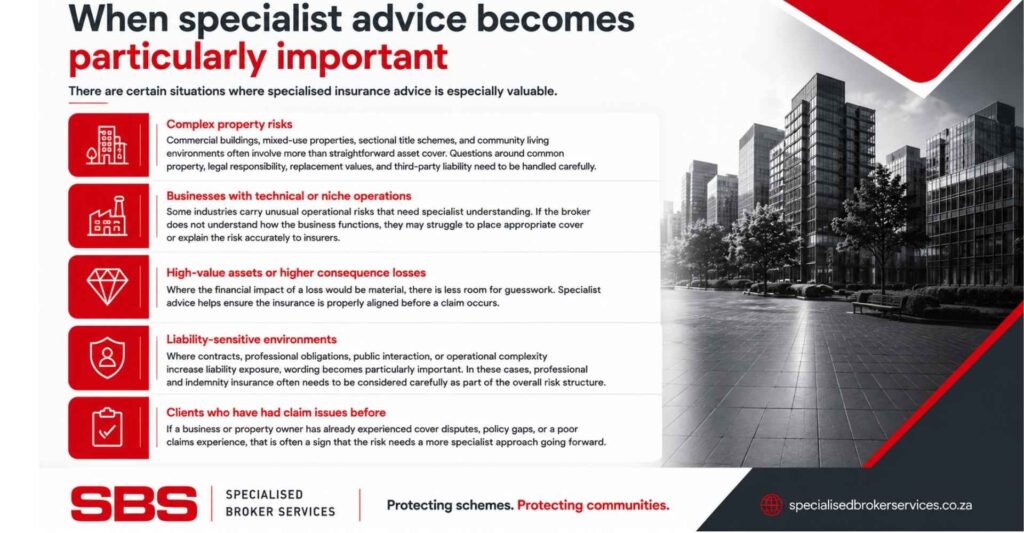
There are certain situations where specialised insurance advice is especially valuable.
Complex property risks
Commercial buildings, mixed-use properties, sectional title schemes, and community living environments often involve more than straightforward asset cover. Questions around common property, legal responsibility, replacement values, and third-party liability need to be handled carefully.
Businesses with technical or niche operations
Some industries carry unusual operational risks that need specialist understanding. If the broker does not understand how the business functions, they may struggle to place appropriate cover or explain the risk accurately to insurers.
High-value assets or higher consequence losses
Where the financial impact of a loss would be material, there is less room for guesswork. Specialist advice helps ensure the insurance is properly aligned before a claim occurs.
Liability-sensitive environments
Where contracts, professional obligations, public interaction, or operational complexity increase liability exposure, wording becomes particularly important. In these cases, professional and indemnity insurance often needs to be considered carefully as part of the overall risk structure.
Clients who have had claim issues before
If a business or property owner has already experienced cover disputes, policy gaps, or a poor claims experience, that is often a sign that the risk needs a more specialist approach going forward.
Why claims are often the real test
A policy schedule can look reassuring. Renewal documents can feel complete. It is only when a claim is lodged that the real quality of the insurance arrangement begins to show. Claims test whether the cover was structured properly, whether the wording says what the insured thought it said, and whether the broker can guide the process effectively. This is why claims stage is often the clearest point of differentiation between transactional insurance and genuinely well-advised insurance.
A specialist broker cannot guarantee that every claim will be paid. No broker should promise that. What they can do is help reduce avoidable claim problems by making sure the risk is understood, the cover is better aligned, and the insured is supported by someone who understands both the policy and the context of the loss. In practical terms, specialist brokers often assist by:
- Making sure relevant information was disclosed correctly
- Checking that values and limits were appropriate
- Helping frame the claim clearly and accurately
- Identifying wording that supports the insured’s position
- Managing communication where technical interpretation is needed
For clients with complex risk, that support can make a meaningful difference in both speed and outcome.
Do specialist brokers cost more?
This question comes up often, and understandably so. Many clients assume that specialist advice must automatically mean higher cost. That is not always the case.
Specialised insurance brokers are not simply charging for access to insurance products. They are providing in depth analysis, structuring insight, and often a stronger level of support across the policy lifecycle. In many cases, that adds value that far outweighs any difference in fee or premium. There are also situations where specialist input may improve value rather than increase cost. A better-structured risk presentation can help avoid unnecessary overlap, support more appropriate insurer engagement, and reduce the likelihood of expensive surprises later.
The more useful question is this: what is the cost of inadequate advice?
If a policy is placed cheaply but fails to respond when it matters, or if an avoidable claims issue creates significant loss, the original savings become much less meaningful. For this reason, complex risk should be assessed in terms of overall protection and long-term value, not just initial premium.
How to tell whether you need a specialist broker
Many clients are unsure whether their insurance needs are complex enough to justify specialist input. A useful starting point is to consider the consequences of getting the insurance wrong. You are more likely to need specialist advice if:
- Your assets are high-value or difficult to replace
- Your operations involve technical, legal, or contractual complexity
- A claim would materially affect business continuity or financial stability
- Multiple stakeholders are involved in the insured risk
- Your policy wording and extensions need scrutiny
- You have experienced confusion or dissatisfaction at the claim stage before
- Your current insurance feels generic or insufficiently tailored
- You need more than a quote comparison
If any of these apply, a specialised insurance adviser is worth considering. Insurance should give confidence, not uncertainty. If the protection in place feels unclear, it may be a sign that the risk needs closer attention. For many businesses, this starts with reviewing whether their current commercial insurance arrangement actually reflects their real operational exposure and not just a standard package.
Choosing the right broker for complex insurance needs
Not every broker who claims to be a specialist truly operates that way. It is therefore worth asking the right questions before making a decision.
Consider whether the broker:
- understands your type of risk in practical terms
- can explain likely problem areas clearly
- reviews wording and policy structure in detail
- takes time to understand your operations or assets
- supports clients properly through claims
- offers advice that goes beyond sourcing quotations
- communicates clearly without relying on vague promises
A good broker should be able to explain not only what is covered, but also where the pressure points or limitations may exist. They should be comfortable discussing limits, exclusions, assumptions, and trade-offs in a way that helps you make informed decisions. That level of clarity is often one of the strongest indicators of true expertise.
Why expertise matters more over time
Insurance needs do not stand still. Businesses grow, asset values change, legal obligations evolve, and risk profiles shift over time. A policy that was adequate three years ago may no longer be adequate today. This is another reason why specialist advice matters. A specialist broker is more likely to review the insurance in context, not just renew it as an annual exercise. They can help clients keep cover aligned with changing realities, rather than allowing outdated assumptions to continue year after year. That proactive approach is often what separates long-term resilience from short-term convenience.
Clients with complex risk do not only need a broker at renewal. They need a trusted adviser who helps them think ahead, spot issues early, and maintain confidence that the insurance programme still reflects the exposure it is meant to protect.
When Insurance Advice Needs More Depth
The difference between a specialist and a general insurance broker is not about prestige or labels. It is about fit, depth, and the quality of advice behind the cover. For straightforward insurance needs, a general broker may be perfectly suitable. But where risk is more complex, commercially significant, technically nuanced, or claims-sensitive, specialist insurance advice becomes far more important.
At that level, insurance is no longer simply about obtaining a policy at a competitive price. It is about making sure the cover is properly structured, the wording reflects the real exposure, and the client has the right support if something goes wrong.
That is why expertise matters.
A specialised insurance broker brings more than market access. They bring judgment, technical understanding, and a stronger ability to align insurance with real-world risk. For businesses, property stakeholders, trustees, and clients facing more complex exposures, that can make all the difference between cover that looks fine on paper and cover that truly stands up when tested.
If you would like to review whether your current insurance structure matches the complexity of your risk, you can contact Specialised Broker Services or book a Zoom meeting with the team.
Frequently Asked Questions
A general insurance broker usually assists with a broad range of standard insurance needs, while a specialist broker focuses on more complex or technical risks. Specialist brokers tend to offer deeper risk analysis, more detailed policy structuring, and stronger support where claims or cover interpretation may be more complicated.
You should consider a specialist broker when your insurance needs involve complex property, community schemes, commercial risks, high-value assets, contractual obligations, or situations where a claim could have serious financial consequences.
Specialist brokers improve claims outcomes by helping structure the cover correctly from the start, identifying possible gaps before a loss happens, and supporting the claims process with stronger technical understanding and clearer interpretation of policy wording.
Not necessarily. Specialist advice may create better value by reducing the risk of cover gaps, underinsurance, and claim disputes. The real question is often not whether the advice costs more, but whether poor advice could cost far more later.
Clients with complex property risks, community schemes, specialised business operations, significant liability exposures, or high-value assets often benefit most from specialist insurance advice because their risks need more careful analysis and policy structuring.